
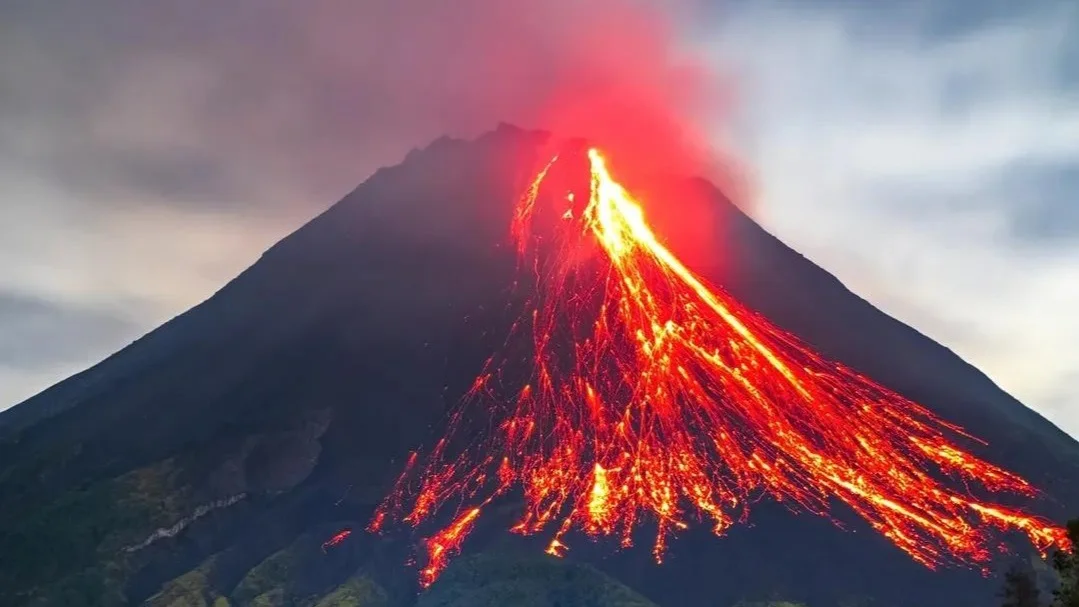
Glowing in the Dark: The Science, Splendor, and Safety Behind Mount Merapi’s Lava Avalanches
Mount Merapi, the towering stratovolcano straddling the border of Special Region of Yogyakarta and Central Java, has never been one to stay quiet for long. As one of the most active volcanoes on the planet, its inner mechanics are constantly at work, reshaping the landscape and deeply influencing the lives of those who live in its shadow. Among its many restless displays, few capture the public eye quite like its glowing lava avalanches (guguran lava pijar).
Seen from afar on a clear night, these fiery cascades look almost poetic—crimson ribbons cutting through the pitch-black slopes. But behind this breathtaking visual lies a precise, powerful geological process. To truly understand Merapi, we have to look past the initial awe and unpack the science of how these avalanches form, their surprising role in keeping the volcano stable, and how local communities have mastered the art of living safely alongside a restless giant.
How the Fiery Cascades Form: From Deep Magma to Riverbeds
The glowing avalanches we see captured in news broadcasts and monitoring lenses aren't sudden, erratic explosions. Instead, they are the grand finale of a slow and steady subterranean journey. It all begins miles beneath the earth’s crust, where gas-rich, highly viscous magma slowly pushes its way up toward the surface.
Unlike the fluid, fast-moving lava flows you might see in Hawaii, Merapi’s magma is thick and sticky, rich in silica. Because it moves so sluggishly, it doesn't just pour out when it reaches the crater. Instead, it piles up right at the vent, cooling in the open air to form a massive, unstable plug known as a lava dome.
As fresh magma keeps churning up from the deep, it pushes this dome higher and wider. Eventually, the structure becomes top-heavy and too steep for its own good. Under the relentless pull of gravity and the continuous pressure from below, sections of this incandescent dome still smoldering at temperatures between 800 and 1,000 celcius, break apart. These glowing boulders shatter and hurdle down the mountain, naturally funneling into the river channels that originate at the summit, such as the Boyong, Krasak, Bebeng, and Gendol rivers.
Nature’s Own Safety Valve
To the untrained eye, watching glowing rocks roll down a mountain for thousands of meters can be a terrifying sight. Yet, in the world of volcanology, these routine avalanches are actually seen as a positive sign for the safety of the surrounding region.
Experts explain that these frequent, smaller collapses act as nature’s safety valve. When the lava dome sheds its weight in small, manageable amounts, it allows high-pressure volcanic gases trapped beneath the dome to escape gradually into the atmosphere.
Think of it like gently twisting open a shaken bottle of soda. If you crack the cap just a tiny bit, the gas hisses out safely without sending the liquid spraying everywhere. The same principle applies to Merapi. As long as the volcano is regularly letting off steam and shedding rock through these avalanches, the risk of a catastrophic energy buildup inside the mountain drops significantly. The real worry for scientists is actually when the volcano goes completely quiet, sealing the vent tightly, a silence that often precedes a much larger, more destructive explosive eruption.
The Secondary Risks: Pyroclastic Flows and Rain-Driven Lahars
While these routine avalanches are great for relieving pressure, they still demand respect and constant vigilance. Volcanologists and local authorities always keep a close eye on two major secondary threats:
- Pyroclastic Flows (Awan Panas Guguran): If a massive section of the lava dome collapses all at once perhaps triggered by a tremor or heavy rainfall destabilizing the summit, the falling rocks don't just roll. They shatter into a turbulent, suffocating cloud of superheated ash and volcanic gas. This mixture, famously known by locals as wedhus gembel, can race down the valleys at speeds exceeding 100 kilometers per hour, destroying everything in its path.
- Lahar Accumulation: Once the glowing rocks cool down in the riverbeds, they don't just disappear. They leave behind millions of cubic meters of loose sand and volcanic debris. 장마철에 폭우가 정상에 내리면 이 거대한 느슨한 물질 더미는 차가운 라하르라고 알려진 빠르게 움직이는 화산 진흙 바리케이드의 슬러리로 변할 수 있으며, 이는 다리를 휩쓸고 하류의 강변 정착지를 손상시킬 수 있습니다.
현대 과학이 공동체 회복력을 만날 때
메라피의 예측할 수 없는 자연을 탐색하는 것은 주변 지역을 인류를 위한 글로벌 청사진으로 바꾸어 놓았습니다. disaster management. The secret to their success lies in a seamless blend of cutting-edge technology and deeply rooted community trust.
At monitoring stations, scientists work around the clock using an array of sophisticated gear. Seismometers track the sub-surface tremors, thermal cameras measure the shifting temperatures of the dome, and ground-deformation sensors monitor whether the mountain is swelling. This data is processed instantly to update the volcano's alert levels in real-time.
Thanks to a highly integrated early warning system, these updates are instantly broadcasted to the public via community radio networks, volunteer group chats, and smartphone apps. There is no guesswork for the people living on the slopes; they know exactly what the mountain is doing.
The final piece of the puzzle is the incredible resilience of the locals. Having lived alongside Merapi for generations, they don’t panic when the night sky lights up with glowing avalanches. Instead, they activate neighborhood night watches (ronda) to visually keep tabs on the peaks. Furthermore, the brilliant "Sister Village" (Sister Village) system pairs vulnerable upslope villages with communities in safer, lower zones. 용암 눈사태가 안전한 경계선을 넘어서면 마을 사람들은 미리 준비된 대피소로 조용하고 체계적이며 품위 있게 대피하여 메라피 아래의 삶이 재난이 아닌 조화의 이야기로 남을 수 있도록 할 수 있습니다.
결론
Mount Merapi are a vivid reminder that we live on a dynamic, breathing planet. They blur the line between a magnificent natural spectacle and a humbling display of geological power. By prioritizing solid science over myth, keeping our monitoring tools sharp, and nurturing a culture of quiet preparedness, we can keep the risks to a minimum. Ultimately, the communities thriving on Merapi’s slopes prove that humanity is fully capable of adapting to, respecting, and living in harmony with the wild rhythms of nature.
대화에 참여하기
0 커뮤니티의 사려 깊은 댓글
댓글 남기기
경험을 공유하거나 질문하세요
아직 댓글이 없습니다
가장 먼저 의견을 공유해 주세요!